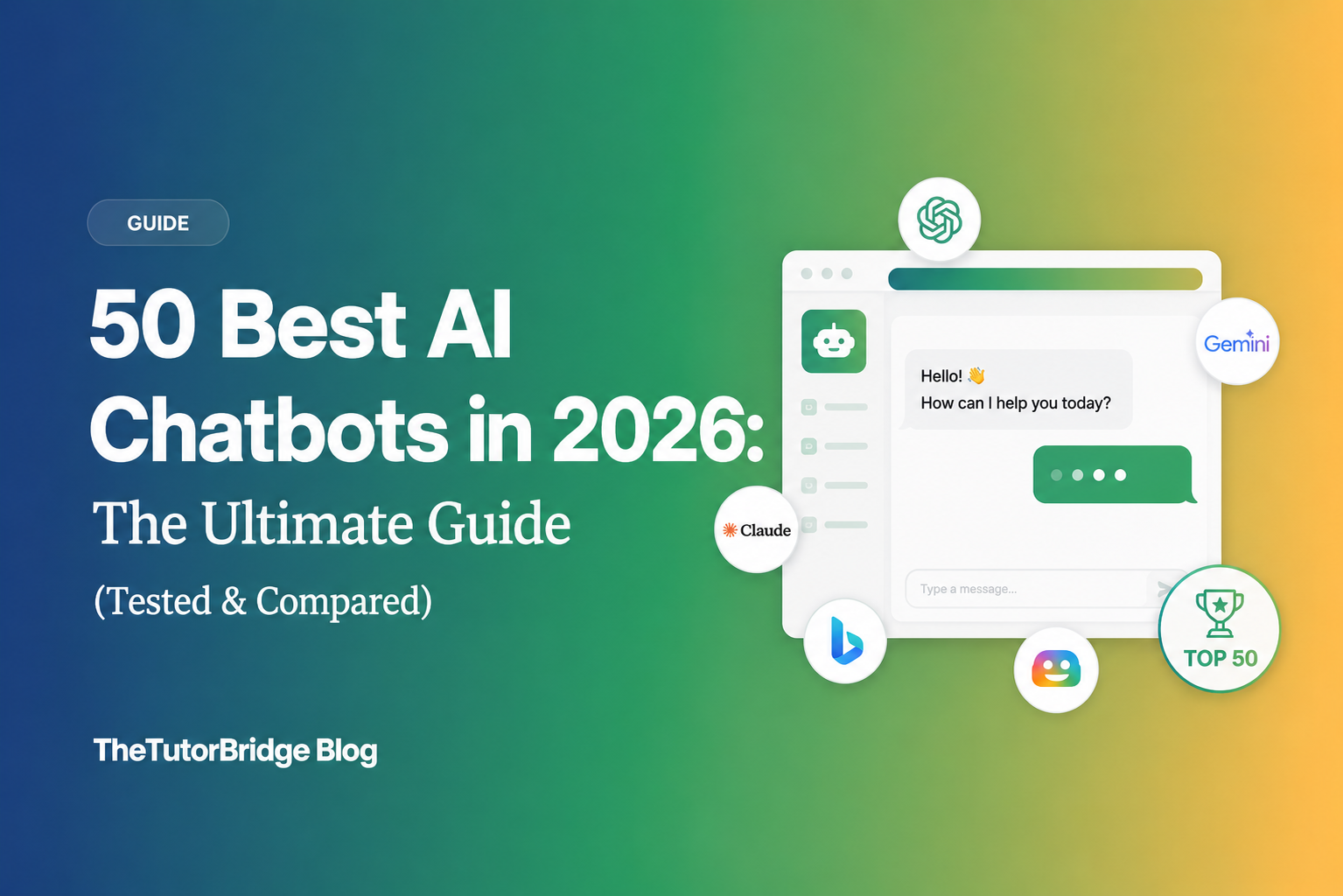
50 Best AI Chatbots in 2026: The Ultimate Guide (Tested & Compared)
What Are AI Chatbots and Why Do They Matter in 2026?
AI chatbots have transformed from experimental curiosities into indispensable productivity tools. In 2026, over 900 million people use ChatGPT alone each week, and the broader AI assistant market has exploded with specialized solutions for every conceivable use case.
Whether you are a student looking to study more effectively, a developer writing code, a marketer creating content, or a business owner automating customer support, there is an AI chatbot designed specifically for your needs.
The challenge is no longer whether to use AI chatbots. The challenge is choosing the right one from dozens of excellent options.
This guide cuts through the noise. We have tested and compared 50 AI chatbots across nine categories, evaluating them on capabilities, pricing, ease of use, and real-world performance. Whether you need a general-purpose assistant, a coding companion, or a specialized industry tool, you will find your answer here.
Quick Answer: What Is the Best AI Chatbot in 2026?
The best AI chatbot depends entirely on your use case:
- Best Overall: ChatGPT (GPT-5 series) — most versatile with the largest ecosystem
- Best for Writing: Claude (Anthropic) — superior prose quality and 200K+ token context
- Best for Research: Perplexity AI — real-time web search with inline citations
- Best for Coding: Cursor AI — 72% suggestion acceptance rate with autonomous agents
- Best Free Option: Google Gemini — most generous free tier with 2M token context on Pro
- Best for Students: Khanmigo — Socratic tutoring method at $4/month
- Best for Customer Service: Intercom Fin — 50%+ autonomous resolution rate
There is no single winner. The most effective strategy is using multiple tools for their respective strengths.
The 50 Best AI Chatbots in 2026: Complete List
Category 1: General Purpose AI Chatbots
These are the versatile workhorses that handle everything from writing and coding to research and creative projects. If you need one AI assistant for multiple tasks, start here.
1. ChatGPT (OpenAI)
Best for: Overall versatility and ecosystem breadth
ChatGPT remains the most widely used AI assistant on the planet, with over 900 million weekly active users in 2026. Running on OpenAI's GPT-5 series, it strikes a balance that few competitors match: approachable for beginners yet sophisticated for developers and enterprise teams.
Key Features:
- Advanced reasoning with GPT-5.4 model
- Web browsing and real-time information
- DALL-E image generation built-in
- Code interpreter for data analysis
- Custom GPTs marketplace
- Memory across conversations
- Voice mode for natural conversations
Pricing:
- Free: GPT-3.5 with limited GPT-5 access
- Plus: $20/month
- Pro: $200/month (unlimited access)
- Enterprise: Custom pricing
Strengths: Largest ecosystem, best all-around capabilities, frequent updates
Weaknesses: Can be verbose, occasional hallucinations, privacy concerns for sensitive data
2. Claude (Anthropic)
Best for: Writing, long documents, and nuanced reasoning
Claude has quietly become the preferred choice for professional writers, researchers, and developers who need thoughtful, well-structured output. Its 200K+ token context window means it can process entire books, codebases, or research papers in a single conversation.
In practice, Claude dominates the developer tooling ecosystem, powering Cursor, Windsurf, and Claude Code. When it comes to natural prose, Claude consistently produces the most human-sounding writing among all major models.
Key Features:
- 200K token context window (largest among proprietary models)
- Artifacts for interactive content creation
- Projects for organizing work
- Constitutional AI for safety
- Claude Code for terminal-based coding
- Superior reasoning on complex tasks
Pricing:
- Free: Limited messages
- Pro: $20/month
- Team: $30/user/month
- Enterprise: Custom pricing
Strengths: Best writing quality, massive context window, thoughtful responses
Weaknesses: No image generation, smaller ecosystem than ChatGPT
3. Google Gemini
Best for: Google Workspace users and research
Gemini is the right choice for anyone whose professional life runs through Google Workspace. The Deep Research feature is genuinely impressive — give it a research question, come back in a few minutes, and you will receive a multi-page structured report with sources.
Gemini's free tier is the most generous of any frontier model, and its 2M-token context on Pro is the largest anywhere.
Key Features:
- 2M token context window on Pro
- Deep Research for comprehensive reports
- Native Google Workspace integration
- Multimodal capabilities (text, image, video, audio)
- Real-time information access
- Extensions for Maps, YouTube, Hotels, Flights
Pricing:
- Free: Generous access to Gemini 1.5 Flash
- AI Plus: $7.99/month
- Pro: $19.99/month
- Ultra: $249.99/month
Strengths: Best Google integration, largest context window, excellent free tier
Weaknesses: Less refined writing than Claude, sometimes verbose
4. Perplexity AI
Best for: Research and fact-finding with citations
Perplexity has quietly become the best tool for research. Its real-time web search with citations beats ChatGPT's browsing mode in most head-to-head tests. Every answer includes inline citations, making it easy to verify claims and dig deeper.
What sets Perplexity apart is the ability to switch between different models like GPT, Claude, and Gemini within the same interface.
Key Features:
- Real-time web search with inline citations
- Multiple AI model access (GPT, Claude, Gemini)
- Focus modes for specific search types
- Collections for organizing research
- API access for developers
- Chrome extension for quick answers
Pricing:
- Free: 5 Pro searches per day
- Pro: $20/month (unlimited Pro searches)
Strengths: Best for cited research, clean interface, model flexibility
Weaknesses: Less capable for creative writing, limited context window
5. Grok (xAI)
Best for: X/Twitter integration and massive context
Built by xAI (Elon Musk's AI company), Grok offers real-time access to X/Twitter data and boasts the largest context window of any chatbot at 1 million tokens. Grok 4 leads raw SWE-bench coding scores at 75%.
Key Features:
- 1M token context window
- Real-time X/Twitter integration
- Unfiltered responses option
- Strong coding capabilities
- Image generation with Aurora
- DeepSearch for comprehensive research
Pricing:
- Included with X Premium+ ($16/month)
- SuperGrok: $30/month (standalone)
Strengths: X integration, massive context, strong coding
Weaknesses: Requires X subscription, less refined than Claude for writing
6. Microsoft Copilot
Best for: Microsoft 365 users
Microsoft Copilot brings GPT-4 (via Azure) directly into Word, Excel, PowerPoint, Outlook, and Teams. For organizations already using Microsoft 365, it is the most seamless AI integration available.
Key Features:
- Native Microsoft 365 integration
- Document drafting in Word
- Data analysis in Excel
- Presentation creation in PowerPoint
- Email assistance in Outlook
- Meeting summaries in Teams
Pricing:
- Free: Basic Copilot access
- Copilot Pro: $20/month (personal)
- Copilot for Microsoft 365: $30/user/month (business)
Strengths: Best Microsoft integration, enterprise-ready, familiar interface
Weaknesses: Requires Microsoft ecosystem, less flexible than standalone chatbots
7. DeepSeek
Best for: Budget-conscious users and developers
DeepSeek has disrupted the AI market with exceptional price-performance ratios. The DeepSeek-V3 model rivals GPT-4 quality at a fraction of the cost, making it attractive for developers and businesses watching their API bills.
Key Features:
- GPT-4 class performance
- Extremely competitive pricing
- Strong reasoning capabilities
- Code generation
- Open-weight models available
- API access with generous limits
Pricing:
- Free tier available
- API: Approximately 1/10th the cost of GPT-4
Strengths: Excellent value, strong performance, competitive API pricing
Weaknesses: Less ecosystem support, privacy concerns for some users
8. Pi (Inflection AI)
Best for: Emotional support and casual conversation
Pi is designed for personal use, emotional support, and general companionship. Its tone is casual and empathetic, with frequent use of emojis and informal phrasing. Unlike productivity-focused chatbots, Pi prioritizes emotional intelligence.
Key Features:
- Empathetic conversational style
- Voice conversations
- Daily check-ins
- Advice and brainstorming
- Judgment-free conversations
- Mobile-first design
Pricing:
- Free (with ads)
- Pi+ subscription available
Strengths: Excellent emotional intelligence, friendly tone, great for daily conversations
Weaknesses: Not designed for productivity tasks, limited capabilities compared to ChatGPT
9. You.com
Best for: Privacy-focused search and research
You.com combines AI chat with web search in a privacy-focused package. It offers multiple AI modes and does not require an account to use, making it attractive for privacy-conscious users.
Key Features:
- Privacy-focused design
- Multiple AI modes (Smart, Research, Create)
- No account required
- Web search integration
- Image generation
- Code assistance
Pricing:
- Free: Basic access
- You Pro: $15/month
Strengths: Privacy-focused, no account required, versatile modes
Weaknesses: Smaller user base, less refined than major competitors
10. HuggingChat
Best for: Open-source AI experimentation
HuggingChat provides free access to open-source models like Llama, Mistral, and others through a simple web interface. It is the best way to experiment with open-source AI without technical setup.
Key Features:
- Access to multiple open-source models
- No account required for basic use
- Web search integration
- Code assistance
- Image understanding
- Completely free
Pricing:
- Free (open source)
Strengths: Free, open-source models, great for experimentation
Weaknesses: Less capable than commercial alternatives, variable performance
Category 2: AI Coding Assistants
For developers, AI coding assistants have become essential productivity tools. These chatbots understand code context, suggest completions, fix bugs, and even write entire functions.
11. GitHub Copilot
Best for: Broad IDE support and established tooling
GitHub Copilot holds approximately 42% market share and is the easiest entry point for beginners and GitHub teams. It now defaults to Claude Sonnet 4 for paid users, offering the widest IDE support of any AI coding tool.
According to GitHub's internal data, Copilot generates code that developers keep roughly 46% of the time.
Key Features:
- Inline code completions
- Chat interface for explanations
- Support for 10+ IDEs
- Claude Sonnet 4 default model
- GitHub integration
- 2,000 free completions/month
Pricing:
- Free: 2,000 completions/month
- Individual: $10/month
- Business: $19/user/month
- Enterprise: $39/user/month
Strengths: Widest IDE support, GitHub integration, established ecosystem
Weaknesses: Lower acceptance rate than Cursor, less autonomous
12. Cursor
Best for: AI-native coding experience and productivity
Cursor is a VS Code fork built from the ground up with AI as a first-class feature. It remains the benchmark for AI-native IDE experiences in 2026, hitting a 72% suggestion acceptance rate after acquiring Supermaven.
Cursor's Composer feature makes it significantly more capable for agentic tasks, allowing the AI to make changes across multiple files autonomously.
Key Features:
- 72% suggestion acceptance rate
- Composer for multi-file changes
- Context-aware completions
- Chat with codebase understanding
- Autonomous agent capabilities
- Tab autocomplete
Pricing:
- Free: Limited requests
- Pro: $20/month
- Business: $40/user/month
Strengths: Best acceptance rate, autonomous agents, excellent context understanding
Weaknesses: Only works in Cursor IDE, higher price than Copilot
13. Windsurf (Codeium)
Best for: Free AI coding with privacy guarantees
Windsurf, made by Codeium and acquired by OpenAI in late 2025 for approximately $3 billion, is the strongest direct competitor to Cursor. Like Cursor, it is a VS Code fork, but its philosophy leans harder toward agentic flows.
The individual tier is completely free with zero data retention guarantees.
Key Features:
- Free unlimited tier for individuals
- Zero data retention
- Agentic coding flows
- Multi-file editing
- Context-aware suggestions
- Enterprise compliance options
Pricing:
- Free: Unlimited for individuals
- Pro: $15/month
- Enterprise: Custom pricing
Strengths: Free tier, privacy guarantees, strong agentic capabilities
Weaknesses: Smaller ecosystem than Copilot, fewer IDE options
14. Tabnine
Best for: Enterprise compliance and on-premises deployment
Tabnine has been around longer than Copilot and has strong enterprise positioning with on-premises deployment options. Named a Visionary in the 2025 Gartner Magic Quadrant for AI Code Assistants, it is the choice for teams with strict data residency requirements.
The Enterprise Context Engine, launched February 2026, learns an organization's architecture, frameworks, and coding standards.
Key Features:
- On-premises deployment option
- Air-gapped deployment available
- SOC 2, ISO 27001, GDPR certified
- Enterprise Context Engine
- Custom model training
- Broad IDE support
Pricing:
- Free: Basic completions
- Pro: $12/month
- Enterprise: $39/user/month
Strengths: Best compliance, on-premises option, enterprise-ready
Weaknesses: Less capable than Cursor/Windsurf for agentic work
15. Claude Code
Best for: Terminal-based agentic coding
Claude Code is Anthropic's terminal-based AI coding assistant that understands your entire codebase and can make changes autonomously. It excels at complex, multi-file refactoring tasks.
Key Features:
- Terminal-based interface
- Full codebase understanding
- Autonomous multi-file changes
- Git integration
- Test running and debugging
- Project context awareness
Pricing:
- Included with Claude Pro ($20/month)
- API usage based
Strengths: Excellent for complex tasks, full codebase context, autonomous operation
Weaknesses: Terminal-only interface, steeper learning curve
16. Amazon CodeWhisperer (Amazon Q Developer)
Best for: AWS integration
Amazon CodeWhisperer, now part of Amazon Q Developer, provides AI code suggestions optimized for AWS services. It is the natural choice for teams heavily invested in the AWS ecosystem.
Key Features:
- AWS service optimization
- Security scanning
- Reference tracking
- Multiple IDE support
- Free for individual use
- Enterprise SSO support
Pricing:
- Free: Individual developers
- Professional: $19/user/month
Strengths: Best AWS integration, security scanning, free individual tier
Weaknesses: Less capable outside AWS, smaller community
17. Replit AI (Ghostwriter)
Best for: Learning to code and quick prototypes
Replit AI provides AI assistance directly in the browser-based Replit IDE. It is particularly valuable for beginners learning to code and for rapid prototyping.
Key Features:
- Browser-based IDE
- Code generation and explanation
- Debugging assistance
- Multiple language support
- Instant deployment
- Collaborative features
Pricing:
- Free: Limited AI features
- Replit Core: $25/month
- Teams: Custom pricing
Strengths: No setup required, great for learning, instant deployment
Weaknesses: Less powerful than desktop IDEs, limited for large projects
Category 3: Customer Service AI Chatbots
These chatbots handle customer inquiries, automate support, and integrate with help desks. They can dramatically reduce support costs while improving response times.
18. Intercom Fin
Best for: Complete AI customer service
Intercom's AI agent Fin handles customer inquiries end-to-end, pulling answers from your knowledge base, documentation, and previous conversations. According to Intercom's benchmarks, Fin can handle 50%+ of customer questions autonomously when trained on a solid knowledge base.
Key Features:
- 50%+ autonomous resolution rate
- Knowledge base integration
- Conversation history learning
- Seamless human handoff
- Multilingual support
- Analytics dashboard
Pricing:
- Starting at $29/seat/month + $0.99 per resolution
Strengths: High resolution rate, excellent knowledge base integration, proven at scale
Weaknesses: Per-resolution pricing can add up, requires good knowledge base
19. Zendesk AI
Best for: Enterprise-scale support
Zendesk AI Agents automate customer support using autonomous bots that handle inquiries, route tickets, and provide instant answers. Its biggest strength is scalability — Zendesk AI can manage millions of tickets while maintaining consistency.
Key Features:
- Autonomous ticket handling
- Intelligent routing
- Omnichannel support (email, chat, social)
- Deep Zendesk Suite integration
- Sentiment analysis
- Customizable bot flows
Pricing:
- Suite: Starting at $19/agent/month
- Advanced AI add-on: ~$50/agent/month
Strengths: Enterprise scale, omnichannel, proven reliability
Weaknesses: Complex setup, expensive at scale
20. Tidio (Lyro AI)
Best for: E-commerce and small businesses
Tidio's Lyro AI agent achieves a 67% autonomous resolution rate with smooth integrations across platforms. Its chat flow builder makes it straightforward for users to get started without technical expertise.
Key Features:
- 67% autonomous resolution rate
- Visual chat flow builder
- E-commerce integrations (Shopify, WooCommerce)
- Live chat fallback
- Visitor tracking
- Mobile app
Pricing:
- Free: Limited features
- Lyro AI: Starting at $32.50/user/month (50 AI conversations)
Strengths: Easy setup, great for e-commerce, affordable
Weaknesses: Limited enterprise features, conversation limits
21. Drift
Best for: B2B sales and ABM
Drift, now owned by Salesloft, sits at the intersection of customer service and sales. The AI engages website visitors, qualifies leads, books meetings, and handles support inquiries in one platform.
Key Features:
- Visitor identification
- Lead qualification
- Meeting scheduling
- Sales routing
- Account-based targeting
- Revenue intelligence
Pricing:
- Custom pricing (typically enterprise-focused)
Strengths: Excellent for B2B, sales integration, visitor intelligence
Weaknesses: Expensive, overkill for simple support needs
22. Freshdesk (Freddy AI)
Best for: Mid-market support teams
Freshdesk's Freddy AI provides intelligent ticket routing, suggested responses, and autonomous resolution within the affordable Freshdesk ecosystem.
Key Features:
- Intelligent ticket routing
- Suggested responses
- Auto-resolution
- Knowledge base suggestions
- Sentiment analysis
- Multiple channel support
Pricing:
- Free: Basic features
- Growth: $15/agent/month
- Pro: $49/agent/month
- Enterprise: $79/agent/month
Strengths: Affordable, easy to use, good automation
Weaknesses: Less sophisticated than Zendesk, limited customization
23. Ada
Best for: Automated resolution at scale
Ada specializes in automated customer service with a focus on self-service resolution. It handles complex, multi-turn conversations without human intervention.
Key Features:
- Multi-turn conversation handling
- 30+ language support
- Brand voice customization
- Analytics and insights
- Integration ecosystem
- No-code builder
Pricing:
- Custom pricing based on volume
Strengths: High automation rate, multilingual, no-code setup
Weaknesses: Expensive, requires significant training
24. Salesforce Agentforce
Best for: Salesforce ecosystem
Salesforce Agentforce brings AI-powered service directly into Service Cloud, with deep CRM integration and comprehensive customer context.
Key Features:
- Native Salesforce integration
- Full customer context
- Einstein AI capabilities
- Omnichannel routing
- Knowledge base integration
- Advanced analytics
Pricing:
- Included with Service Cloud (starting at $25/user/month)
- Einstein features additional
Strengths: Best Salesforce integration, full customer context
Weaknesses: Requires Salesforce ecosystem, complex setup
25. Gorgias
Best for: E-commerce customer service
Gorgias is built specifically for e-commerce, with deep integrations into Shopify, BigCommerce, and Magento. It provides order information, shipping updates, and refund processing directly in the chat.
Key Features:
- E-commerce platform integrations
- Order management in chat
- Revenue attribution
- Social media support
- Macro automation
- Customer context sidebar
Pricing:
- Starter: $10/month (50 tickets)
- Basic: $60/month (300 tickets)
- Pro: $360/month (2,000 tickets)
- Advanced: $900/month (5,000 tickets)
Strengths: Best for e-commerce, order integration, revenue tracking
Weaknesses: Only for e-commerce, ticket-based pricing
Category 4: AI Writing & Content Tools
These chatbots specialize in creating marketing copy, blog posts, social media content, and other written materials. While general-purpose chatbots like Claude excel at writing, these tools offer specialized features for content teams.
26. Jasper AI
Best for: Enterprise content teams
Jasper remains the gold standard for large marketing teams that need one voice across 50 content channels. Its Brand Voice engine maintains style guide, tone preferences, and audience profiles with impressive consistency.
Key Features:
- Brand Voice engine
- 50+ content templates
- Campaign workflows
- Team collaboration
- SEO optimization
- Chrome extension
Pricing:
- Creator: $49/month
- Pro: $69/month
- Business: Custom pricing
Strengths: Best brand consistency, template library, enterprise features
Weaknesses: Expensive, general chatbots now match quality
27. Copy.ai
Best for: Sales and marketing copy
Copy.ai has made a smart pivot in 2026, focusing on go-to-market workflows rather than long-form content. It generates ad copy, email subject lines, LinkedIn posts, and sales sequences faster than other tools.
Key Features:
- Workflow automation
- CRM integration
- Sales sequence generation
- Ad copy templates
- Brand voice training
- API access
Pricing:
- Free: 2,000 words/month
- Pro: $36/month (unlimited)
- Enterprise: Custom pricing
Strengths: Excellent for short-form, workflow automation, CRM integration
Weaknesses: Less capable for long-form, expensive for light use
28. Writesonic
Best for: SEO-focused content
Writesonic is the standout winner for content teams focused on search rankings. Its Article Writer 6.0 integrates with Surfer SEO and Semrush, running real-time SERP analysis and structuring content around actual search intent.
The 2026 addition of AI Search Visibility (GEO) tracks where your brand appears in ChatGPT, Gemini, and Google AI Overview responses — a feature no other tool offers.
Key Features:
- SEO integration (Surfer, Semrush)
- SERP analysis
- AI Search Visibility tracking
- Multiple content formats
- Bulk generation
- WordPress integration
Pricing:
- Free: 10,000 words/month
- Individual: $12.67/month (200K words)
- Unlimited: Starting at $16/month
Strengths: Best SEO integration, AI visibility tracking, affordable
Weaknesses: Less polished writing than Jasper
29. Rytr
Best for: Budget-conscious creators
At $9/month, Rytr is in a completely different pricing tier, offering 40+ use case templates, 30+ language support, and a built-in plagiarism checker. It is ideal for freelancers or solopreneurs who need quick first drafts.
Key Features:
- 40+ use case templates
- 30+ language support
- Plagiarism checker
- SEO analyzer
- Rich text editor
- Chrome extension
Pricing:
- Free: 10,000 characters/month
- Saver: $9/month (100K characters)
- Unlimited: $29/month
Strengths: Most affordable, multilingual, built-in tools
Weaknesses: Long-form loses coherence, basic features
30. Wordtune
Best for: Quick sentence-level rewrites
Wordtune provides highly polished rewrites with almost effortless improvement in tone and flow. It excels at sentence-level editing rather than full content generation.
Key Features:
- Sentence rewriting
- Tone adjustment
- Expansion and shortening
- Summarization
- Chrome extension
- Spices for inspiration
Pricing:
- Free: 10 rewrites/day
- Plus: $13.99/month
- Unlimited: $24.99/month
- Business: Custom
Strengths: Excellent for editing, natural tone improvement
Weaknesses: Not for content generation, limited free tier
31. QuillBot
Best for: Paraphrasing and academic writing
QuillBot is famous for its paraphrasing tool, helping rewrite awkward sentences to flow better or sound more academic. It also offers summarization, grammar checking, and citation generation.
Important note: Turnitin released a late 2025 update that specifically detects AI-paraphrased content. Students should be cautious about using QuillBot to disguise AI-generated text.
Key Features:
- Multiple paraphrasing modes
- Grammar checker
- Summarizer
- Citation generator
- Plagiarism checker
- Word and Chrome extensions
Pricing:
- Free: 125 words per paraphrase
- Premium: $4.17/month (billed annually)
Strengths: Best paraphrasing, affordable, academic focus
Weaknesses: AI detection risk, word limits on free tier
Category 5: AI Education & Learning Chatbots
These chatbots are designed specifically for education, helping students learn, practice, and understand concepts through interactive conversation.
32. Khanmigo (Khan Academy)
Best for: Structured learning and tutoring
Khanmigo is Khan Academy's AI-powered tutor and the best AI tool for studying foundational subjects including math, science, economics, and standardized test preparation like the SAT and LSAT.
Unlike chatbots that simply give answers, Khanmigo guides students through problems using the Socratic method — asking questions that lead them to the solution themselves.
Key Features:
- Socratic tutoring method
- Math, science, economics coverage
- SAT/LSAT preparation
- Writing assistance (guides, not writes)
- Safe for younger students
- Progress tracking
Pricing:
- $4/month for students
- Free for teachers
- District pricing available
Strengths: Best educational AI, Socratic method, affordable
Weaknesses: Limited to Khan Academy content, won't write essays
33. Socratic (Google)
Best for: Homework help across subjects
Socratic is a free AI tool allowing students to photograph or type a homework problem and receive step-by-step explanations, visual breakdowns, and links to related learning resources.
Key Features:
- Photo problem recognition
- Step-by-step explanations
- Visual breakdowns
- Multiple subject coverage
- Learning resource links
- Completely free
Pricing:
- Free (no paid tier)
Strengths: Free, visual explanations, easy to use
Weaknesses: Limited depth, no tutoring interaction
34. Duolingo Max
Best for: Language learning
Duolingo Max adds AI-powered features to the popular language learning app, including Explain My Answer (grammar explanations) and Roleplay (conversational practice with AI characters).
Key Features:
- Explain My Answer feature
- Roleplay conversations
- Personalized lessons
- Multiple languages
- Gamified learning
- Progress tracking
Pricing:
- Free: Basic Duolingo
- Super: $7/month
- Max: $30/month (AI features)
Strengths: Best for language learning, engaging format
Weaknesses: Expensive for AI features, limited to languages
35. Photomath
Best for: Math problem solving
Photomath uses AI to solve math problems from photos, showing step-by-step solutions. It is invaluable for students learning mathematics who want to understand the process, not just the answer.
Key Features:
- Photo problem recognition
- Step-by-step solutions
- Multiple solution methods
- Animated explanations
- Calculator functions
- Offline support
Pricing:
- Free: Basic solutions
- Plus: $9.99/month (detailed steps)
Strengths: Excellent for math, shows process, visual explanations
Weaknesses: Math only, premium needed for full explanations
36. Caktus AI
Best for: Student productivity
Caktus AI is designed specifically for students, offering essay assistance, citation generation, and study tools. It positions itself as an ethical AI assistant for academic work.
Key Features:
- Essay outlining and drafting
- Citation generation
- Math problem solving
- Code assistance
- Study guides
- Multiple subjects
Pricing:
- Free trial
- Premium: $9.99/month
Strengths: Student-focused, multiple subjects, citation help
Weaknesses: Quality variable, academic integrity concerns
Category 6: Sales & Marketing AI Chatbots
These chatbots focus on lead generation, qualification, and sales automation, helping teams convert website visitors into customers.
37. Conversica
Best for: Automated lead follow-up
Conversica provides AI-powered revenue digital assistants that conduct two-way conversations via email and SMS. The platform focuses on automated lead follow-up, engaging prospects through multi-touch sequences that feel like human communication.
Key Features:
- Email and SMS conversations
- Multi-touch sequences
- Lead qualification
- Hot lead escalation
- CRM integration
- Conversation analytics
Pricing:
- Custom pricing (enterprise-focused)
Strengths: Excellent follow-up automation, natural conversations
Weaknesses: Expensive, enterprise-only
38. Qualified
Best for: Salesforce-centric revenue teams
Qualified is a pipeline generation platform built specifically for Salesforce-centric revenue teams. It excels at spotting high-value visitors from target accounts who are on your website and instantly connecting them with the right sales rep.
Key Features:
- Real-time visitor identification
- Salesforce integration
- Account-based routing
- Buyer intent signals
- Meeting scheduling
- Pipeline attribution
Pricing:
- Custom pricing (starting ~$3,000/month)
Strengths: Best Salesforce integration, real-time routing
Weaknesses: Expensive, requires Salesforce
39. Salesforce Einstein Bots
Best for: Native Salesforce AI
Salesforce Einstein Bots provide AI-powered chat capabilities built directly into Sales Cloud and Service Cloud. For enterprises already invested in Salesforce, Einstein eliminates integration headaches.
Key Features:
- Native Salesforce integration
- Lead scoring
- Next-best-action recommendations
- Automated data entry
- Conversation routing
- Analytics and reporting
Pricing:
- Included with Salesforce (varies by edition)
- Einstein features may require additional licensing
Strengths: Seamless Salesforce integration, no third-party needed
Weaknesses: Requires Salesforce, can be complex to configure
40. HubSpot Chatbot Builder
Best for: Inbound marketing teams
HubSpot's Chatbot Builder integrates with the full HubSpot CRM suite, making it ideal for teams already using HubSpot for marketing and sales.
Key Features:
- Visual bot builder
- CRM integration
- Lead qualification
- Meeting scheduling
- Knowledge base integration
- Conversation routing
Pricing:
- Free: Basic features
- Starter: $20/month
- Professional: $890/month
- Enterprise: $3,600/month
Strengths: HubSpot integration, easy to use, free tier
Weaknesses: Best with HubSpot ecosystem, limited AI without premium
41. Knock AI
Best for: B2B pipeline generation
Knock AI routes intent-qualified buyers via Slack and LinkedIn, focusing specifically on B2B pipeline generation with sophisticated intent signals.
Key Features:
- Intent signal detection
- Slack integration
- LinkedIn outreach
- Buyer qualification
- Pipeline routing
- Account identification
Pricing:
- Custom pricing
Strengths: B2B focused, intent signals, multi-channel
Weaknesses: Niche use case, limited information available
Category 7: Open Source & Self-Hosted AI
For those who need data privacy, customization, or cost control, open-source models offer powerful alternatives to commercial chatbots.
42. LLaMA (Meta)
Best for: Self-hosted AI with community support
Llama 4 from Meta continues to be the most widely deployed open source model family, with over 650 million total downloads. The ecosystem advantage is significant: more fine-tunes, more tooling, and more production deployments than any other open model family.
Key Features:
- Multiple model sizes (Scout, Maverick, Behemoth)
- 10M token context window (Scout)
- Wide tooling support (Ollama, LM Studio, vLLM)
- Active community
- Commercial use allowed
- Free weights
Pricing:
- Free (self-hosted)
Strengths: Largest ecosystem, extensive documentation, proven at scale
Weaknesses: Requires technical setup, compute costs
43. Mistral
Best for: European deployment and multilingual
Mistral is Europe's counterweight to US and Chinese models, with exceptional multilingual performance handling French, German, Spanish, Italian, and other European languages better than US-built models.
Devstral 2 scores 72.2% on SWE-bench Verified with 7x cost efficiency compared to Claude Sonnet.
Key Features:
- 123B parameter flagship model
- 128K context window
- 80+ language support
- Devstral for coding
- Apache 2.0 license options
- API and self-hosted options
Pricing:
- Free (open-source models)
- API: Competitive pricing
- Enterprise: Custom
Strengths: Best multilingual, strong coding models, European compliance
Weaknesses: Smaller ecosystem than Llama
44. Ollama
Best for: Easy local model deployment
Ollama is the easiest way to run open models locally — a simple CLI that handles model downloads, quantization, and serving with a single command like ollama run gemma4.
Key Features:
- One-command model running
- Automatic quantization
- Local API server
- Model library
- GPU and CPU support
- Cross-platform (Mac, Linux, Windows)
Pricing:
- Free (open source)
Strengths: Easiest local setup, great documentation, active development
Weaknesses: Requires local compute, model quality varies
45. Open WebUI
Best for: Private ChatGPT alternative
Open WebUI provides a ChatGPT-like interface for local models via Ollama. It is the best choice for teams and individuals who want a private, self-hosted ChatGPT alternative for internal use.
Key Features:
- ChatGPT-like interface
- Ollama integration
- Document upload
- Conversation history
- User management
- Customizable themes
Pricing:
- Free (open source)
Strengths: Familiar interface, full privacy, team features
Weaknesses: Requires technical setup, depends on Ollama
46. LibreChat
Best for: Multi-model access in one interface
LibreChat connects to multiple AI providers (OpenAI, Anthropic, Google, local models) through a single interface — like having ChatGPT, Claude, and Gemini in one app.
Key Features:
- Multiple provider support
- Plugin system
- Conversation branching
- Search functionality
- Docker deployment
- Active community
Pricing:
- Free (open source, bring your own API keys)
Strengths: Multi-model, familiar interface, active development
Weaknesses: Requires API keys/subscriptions, technical setup
Category 8: Entertainment & Companion AI
These chatbots prioritize engagement, entertainment, and emotional connection over productivity.
47. Character.AI
Best for: Creative roleplay and entertainment
Character.AI remains the largest AI character platform in 2026, with 20 million monthly active users spending 75 minutes a day on average. It specializes in conversational AI personalities — fictional, celebrity, historical, or user-created.
Key Features:
- Millions of AI characters
- User-created characters
- Voice chat
- Group chats
- Mobile apps
- Community features
Pricing:
- Free: Basic access
- c.ai+: $9.99/month (priority access, no waiting)
Strengths: Largest character library, engaging, creative use cases
Weaknesses: Content restrictions, not for productivity
48. Replika
Best for: AI companionship and emotional support
Replika is the original AI companion app focused on emotional support, daily check-ins, and simulated relationship dynamics. It builds a persistent relationship with one AI companion over time.
Key Features:
- Persistent AI companion
- Voice and video calls
- Relationship modes
- Memory of past conversations
- Mood tracking
- AR features
Pricing:
- Free: Basic features
- Pro: $70/year (all features)
Strengths: Best for companionship, persistent memory, emotional support
Weaknesses: Controversial features, not for productivity
49. Poe
Best for: Multi-model experimentation
Poe from Quora lets you run the same prompt across Claude, GPT, Gemini, Grok, Llama, and dozens of fine-tuned bots on a single subscription. The compare feature runs multiple models side by side.
Key Features:
- Access to multiple AI models
- Side-by-side comparison
- Custom bot creation
- Bot marketplace
- API access
- Mobile apps
Pricing:
- Free: Limited messages
- Premium: $19.99/month
- Premium+: $249.99/month
Strengths: Best for comparison, multiple models, custom bots
Weaknesses: Message limits, expensive for heavy use
50. Chai
Best for: Mobile entertainment and unfiltered chat
Chai focuses on mobile entertainment with a more permissive content policy than Character.AI. It is popular for casual, unfiltered conversations and entertainment.
Key Features:
- Mobile-first design
- User-created characters
- Less content filtering
- Swipe interface
- Community features
- Free to use
Pricing:
- Free (with ads)
- Premium: Various tiers
Strengths: Mobile-optimized, fewer restrictions, free
Weaknesses: Quality variable, not for productivity
Bonus: Specialized Industry AI Chatbots
These AI chatbots serve specific industries with specialized knowledge and compliance requirements.
Harvey (Legal AI)
Harvey is a legal AI platform tailored for leading law firms and corporate legal teams, streamlining contract analysis, due diligence, compliance, and litigation. Enterprise-focused with limited public information.
Nabla (Healthcare AI)
Nabla delivers clinical-grade AI that supports clinicians with ambient documentation, dictation, and real-time coding. It integrates with all major EHRs, supports 35+ languages, and is used across 130+ health systems. The company has raised $120 million.
Elicit (Research AI)
Elicit uses AI to help researchers search, summarize, and analyze academic papers. It is invaluable for literature reviews and systematic research.
Notion AI
Notion AI brings AI capabilities directly into the Notion workspace, helping with writing, summarization, and task management within your existing notes and databases.
Otter.ai
Otter.ai provides AI-powered meeting transcription and summarization, automatically capturing conversations and generating action items.
Comprehensive AI Chatbot Comparison Table
| Chatbot | Best For | Pricing | Key Strength | Context Window |
|---|---|---|---|---|
| ChatGPT | Overall versatility | Free / $20-200/mo | Largest ecosystem | 128K tokens |
| Claude | Writing & analysis | Free / $20/mo | Best prose quality | 200K tokens |
| Gemini | Google users | Free / $7.99-249/mo | 2M token context | 2M tokens |
| Perplexity | Research | Free / $20/mo | Cited answers | 32K tokens |
| Grok | X/Twitter users | $16-30/mo | X integration | 1M tokens |
| Copilot | Microsoft 365 | Free / $20-30/mo | Office integration | 128K tokens |
| DeepSeek | Budget users | Free / Low API cost | Price-performance | 128K tokens |
| Pi | Companionship | Free | Emotional intelligence | N/A |
| GitHub Copilot | Code completion | Free / $10-39/mo | Widest IDE support | Varies |
| Cursor | AI-native coding | Free / $20/mo | 72% acceptance rate | Full codebase |
| Windsurf | Free coding AI | Free / $15/mo | Privacy guarantees | Full codebase |
| Intercom Fin | Customer service | $29/seat + $0.99/res | 50%+ resolution | N/A |
| Zendesk AI | Enterprise support | $19-69/agent/mo | Scale & reliability | N/A |
| Tidio | E-commerce support | Free / $32.50/mo | Easy setup | N/A |
| Jasper | Enterprise content | $49-69/mo | Brand consistency | N/A |
| Copy.ai | Marketing copy | Free / $36/mo | Workflow automation | N/A |
| Writesonic | SEO content | Free / $12.67/mo | SEO integration | N/A |
| Khanmigo | Student tutoring | $4/mo | Socratic method | N/A |
| Socratic | Homework help | Free | Visual explanations | N/A |
| Character.AI | Entertainment | Free / $9.99/mo | Character variety | N/A |
| Replika | Companionship | Free / $70/yr | Persistent relationship | N/A |
| LLaMA | Self-hosted | Free | Largest open ecosystem | Up to 10M |
| Mistral | Multilingual | Free / API | European languages | 128K tokens |
| Ollama | Local deployment | Free | Easy local setup | Varies |
How to Choose the Right AI Chatbot
For Students
If you are a student looking to improve your study techniques, start with Khanmigo for structured tutoring or Socratic for quick homework help. Both are affordable or free. For writing assistance, Claude produces the most natural prose, but be aware of AI detection tools used by educational institutions.
Recommended stack: Khanmigo + Socratic + Claude Free
For Developers
The current best practice is combining multiple tools: Cursor or Claude Code for complex agentic work, GitHub Copilot for broad IDE support, and an open-source option like Ollama for flexibility. Teams that want this setup running from the first week often hire Claude Code developers who already use agentic coding tools in their daily work.
Recommended stack: Cursor + GitHub Copilot + Ollama
For Writers and Content Creators
Claude consistently produces the best prose among AI chatbots. For marketing-specific content, Jasper (enterprise) or Writesonic (SEO focus) add specialized features. Check out our guide on free AI humanizers to make AI content sound more natural.
Recommended stack: Claude Pro + Writesonic
For Businesses
For customer service, choose based on your existing stack: Intercom Fin for high resolution rates, Zendesk AI for enterprise scale, or Tidio for e-commerce. For sales, Qualified (Salesforce users) or Drift (B2B focus) lead the market. If none of these fit your workflow, you can hire ChatGPT developers to build a custom bot on the OpenAI API that connects to your own systems.
Recommended: Match to your existing CRM/helpdesk platform
For Researchers
Perplexity is the clear winner for research requiring citations. Combine with Claude for analysis of long documents or Elicit for academic paper discovery.
Recommended stack: Perplexity Pro + Claude Pro
For Privacy-Focused Users
Self-host with Ollama and Open WebUI for complete data control. For cloud options, Windsurf offers zero data retention guarantees.
Recommended: Ollama + Open WebUI + LLaMA 4
AI Chatbot Pricing Comparison (2026)
Free Tiers Worth Using
- Google Gemini — Most generous free tier among frontier models
- Perplexity — 5 Pro searches daily
- Socratic — Completely free, no paid tier
- HuggingChat — Full open-source access
- Windsurf — Unlimited free for individuals
Best Value Subscriptions
- Khanmigo — $4/month for educational AI
- Claude Pro — $20/month for best writing
- GitHub Copilot — $10/month for coding
- Writesonic — $12.67/month for SEO content
- Perplexity Pro — $20/month for research
Enterprise Considerations
Enterprise pricing varies significantly based on volume, features, and support requirements. For customer service at scale, expect $50-100+ per agent per month. For content tools, enterprise tiers typically start at several hundred dollars monthly.
Frequently Asked Questions
What is the best free AI chatbot in 2026?
Google Gemini offers the most generous free tier among frontier AI models, with access to Gemini 1.5 Flash and a 2M token context window on Pro. For completely free options, Socratic (education), HuggingChat (general purpose), and Windsurf (coding) are excellent choices.
Is ChatGPT still the best AI chatbot?
ChatGPT remains the most versatile and widely-used AI chatbot with the largest ecosystem. However, Claude produces better writing, Perplexity is superior for research, and Cursor outperforms for coding. The best choice depends on your specific use case.
What is the best AI chatbot for coding?
Cursor leads with a 72% suggestion acceptance rate and powerful autonomous agent capabilities. GitHub Copilot offers the widest IDE support, while Windsurf provides a free alternative with privacy guarantees. For terminal-based work, Claude Code excels at complex multi-file tasks.
What is the best AI chatbot for students?
Khanmigo ($4/month) uses the Socratic tutoring method to guide students through problems rather than just providing answers. Socratic (free) is excellent for quick homework help with visual explanations. For improving focus and study habits, combine these with general-purpose chatbots like Claude.
Are AI chatbots safe for business use?
Enterprise-grade chatbots from established providers (OpenAI, Anthropic, Google, Microsoft) include security certifications, data processing agreements, and compliance features. For sensitive data, consider on-premises solutions like Tabnine or self-hosted options with Ollama. Always review data handling policies before deploying.
What is the difference between ChatGPT and Claude?
ChatGPT (OpenAI) offers broader capabilities and a larger ecosystem, while Claude (Anthropic) produces more natural writing and handles longer documents with its 200K token context window. ChatGPT has image generation built-in; Claude excels at nuanced analysis and coding tasks.
Can AI chatbots replace human workers?
AI chatbots augment rather than replace human workers in most scenarios. Customer service chatbots handle 50-70% of routine inquiries, freeing humans for complex issues. Coding assistants boost productivity 30-50% but require human oversight for quality and security. The most effective approach combines AI efficiency with human judgment.
How do AI chatbots handle privacy?
Privacy practices vary significantly. Ollama and self-hosted options keep all data local. Windsurf offers zero data retention. Enterprise tiers from major providers include data processing agreements and compliance certifications. Free tiers often use conversations for training — review terms carefully for sensitive use cases.
What are the best AI chatbots for small businesses?
For customer service, Tidio offers affordable automation starting at $32.50/month. HubSpot Chatbot Builder has a generous free tier for inbound marketing. Copy.ai ($36/month) handles marketing copy efficiently. General-purpose chatbots like ChatGPT Plus ($20/month) cover many small business needs.
How will AI chatbots evolve in the future?
Key trends include longer context windows (already at 2M tokens), more autonomous agent capabilities, better integration with existing tools, improved reasoning and reduced hallucinations, and multimodal expansion (text, image, video, audio). Expect specialized industry chatbots to multiply as AI proves value in specific domains.
Conclusion: Choosing Your AI Chatbot Stack
The AI chatbot landscape in 2026 is mature enough that there is no single best choice — there is only the best choice for your specific needs.
For most users, starting with ChatGPT or Claude covers general-purpose needs effectively. Add specialized tools as needed: Perplexity for research, Cursor for coding, Khanmigo for learning.
For businesses, match your chatbot selection to your existing technology stack. Salesforce users benefit most from Qualified and Einstein. Microsoft shops should leverage Copilot. E-commerce businesses find value in Tidio or Gorgias.
For privacy-conscious users, the open-source ecosystem has matured significantly. Ollama with LLaMA 4 or Mistral provides capable local AI that never sends data to external servers.
The most important insight from our testing: the best AI strategy uses multiple specialized tools rather than forcing one chatbot to do everything. A developer might use Cursor for coding, Claude for documentation, and Perplexity for research — each tool doing what it does best.
Whatever your needs, the tools exist today to dramatically enhance your productivity. The only question is which combination works best for you.
Related Articles: